
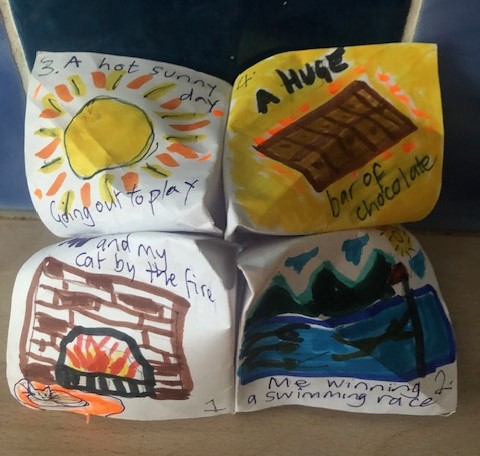
Four pages of reflections on the power of art in this flip book above.
See the Sleep Section of the website as getting your children to draw their dreams [both bad and good] may be a good way to release tensions and celebrate their own self-generated imagery!
A chatterbox origami might appeal to some children and the games associated with it involving others.  Make sure they illustrate it with their own lived experience of characters and visions.
Here is how to create one: https://youtu.be/9DWkkkO8jUg
Have a look at how to make a life story self portrait in this short video:
For an insight into children’s art do have a look at the 2026 entries to the Young Artists Summer Show.  The children whose ages range from 4 to 18 comment on their pictures and give insight into what feelings and thoughts drive them. 
Follow the link to see how art expresses and releases ideas and feelings that words can’t always capture!
SAND ART :   You can look at the shaping and modelling of sand and the placement of objects within a contained space as a sort of art work.  We are all capable of expressing meanings in this way and the symbols can have multiple shifting meanings as a child plays and tells stories in the sand.  Pushing sand through fingers, moving it as feels right and making a landscape are all absorbing actions. Then there is the option of inserting miniatures to represent external forces, people, objects, or inner drives  and this can be dynamic and satisfying.  A large sandbox is great but much can be done with a clean cat litter tray with a blue bottom. The power of a witness to whatever is created can add importance to the exchange.  So much can be experienced in this way without words and it is so important that no judgement is cast by the onlooker and that the child’s timing is respected.  Starting phrases could be :  Can you tell me about your day/your family/ a story of something that happened to you in this sand tray?  Let them first become comfortable with the sand and a limited choice of miniatures. 
Possible words from a child about the story created in the sand tray here are:  ‘The dog was scared but he still asked the unicorn to play with him.  The unicorn made all the other animals change their minds and they came down following the unicorn into the water to play with the dog.  There was an ambulance there in case anyone got hurt and the dog was so pleased to have some friends.’
There are no fixed meanings attached to what is created and it is important to let the unique moment and particular child  help with finding the meaning and only if this is useful. The act of creating a picture in the sand has its own healing power with the witness and the boundaries of the sand acting as a liminal setting that can serve as a safe space for experiment and change.
You may be interested in finding out more about sand tray therapy or art therapy.  There is much out there on You Tube and Chat GPT to discover more.  These words are to remind us that daily life can also offer many opportunities for expressing, and talking about feelings through using sand, clay and art in any of its forms.